
Consumer Products
Nongshim

Building a Faster, Demand-Driven Supply Chain
Nongshim transformed its supply chain around integrated, daily planning—reducing planning cycle time from 72 hours to 4–5 hours, delivery lead time from 24 hours to 8 hours, and the out-of-stock rate from 0.38% to 0.10%.
Company and Project Scope
Nongshim is a leading Korean food manufacturer established in 1965. The company produces noodles, snacks, beverages, instant rice, and other food products, with annual revenue of approximately $2.5 billion as of 2026.
The project covered demand forecasting, inventory replenishment, plant allocation, production planning, transportation planning, and detailed production scheduling. The operational scope included six Nongshim manufacturing plants, one external beverage plant, six central distribution centers (CDCs), and 48 regional distribution centers (RDCs).
Business Challenge
Nongshim needed to improve product availability and freshness without simply increasing finished-goods inventory. The existing process faced recurring stockouts, frequent production-plan changes, long distribution lead times, limited visibility across functions, and material shortages that could disrupt production.
The company therefore focused on creating a more demand-driven supply chain: improve forecast quality, replenish inventory more frequently, connect distribution and production decisions, and shorten the time required to respond when demand or inventory conditions changed.
A Company-Wide Supply Chain Transformation
Beginning in 2007, Nongshim launched a broader process innovation program under the theme "Be the Toyota of the Food Industry — Lean and Fresh." Supply chain management was one of four major transformation initiatives.
- Integrated planning: connect sales and production planning and move to a daily planning cycle.
- Demand-driven distribution: redesign minimum, maximum, and safety-stock policies; introduce cross-docking; and increase replenishment frequency.
- Manufacturing execution: improve master-data accuracy and connect planning more closely with shop-floor execution.
- Purchasing integration: improve material forecasting and support a more responsive just-in-time procurement process.
Key targets included extending the planning horizon from one week to four weeks, reducing finished-goods inventory by 30%, shortening delivery lead time by 50%, and reducing production lead time from five days to three.
One Connected Planning Process
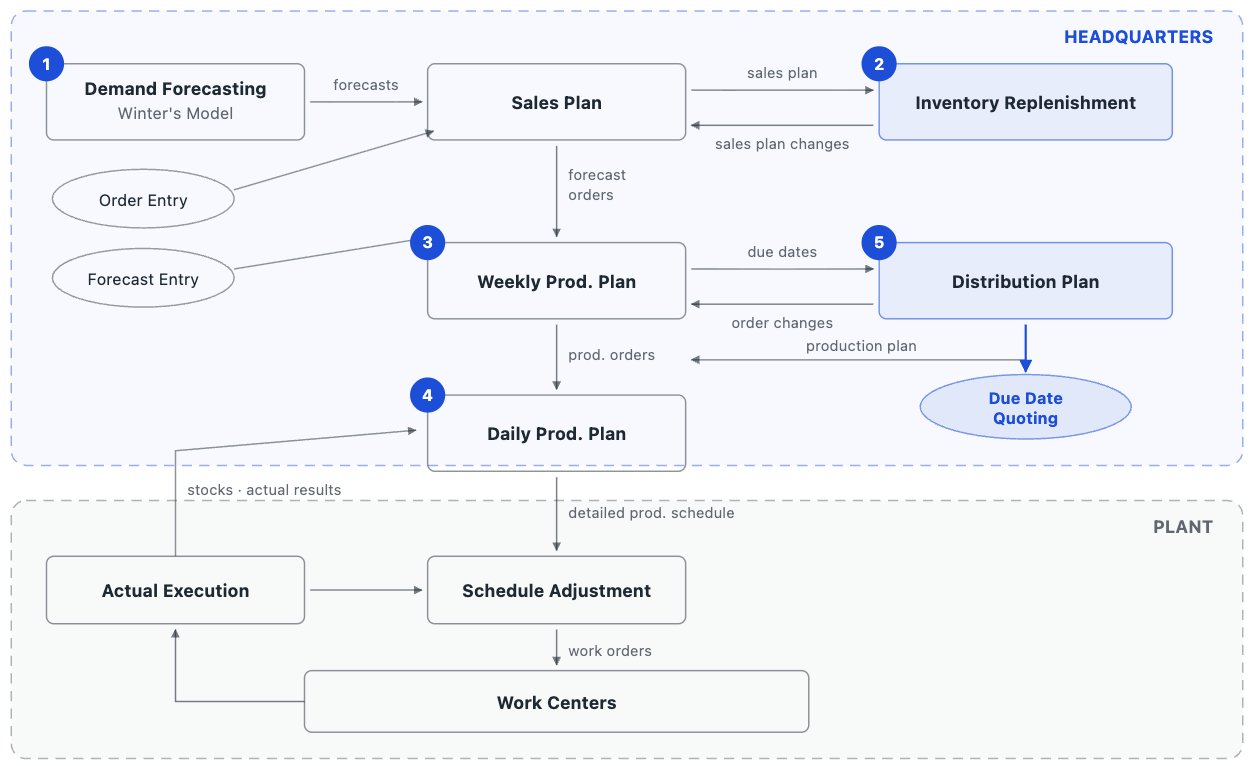
The core design principle was to connect demand, inventory, distribution, and production decisions in one planning process. Demand forecasts feed the sales plan; the sales plan drives replenishment requirements; replenishment and plant allocation determine where supply should come from; and detailed schedules translate those decisions into executable production plans.
Demand Planning: Focus Where Forecast Error Matters Most
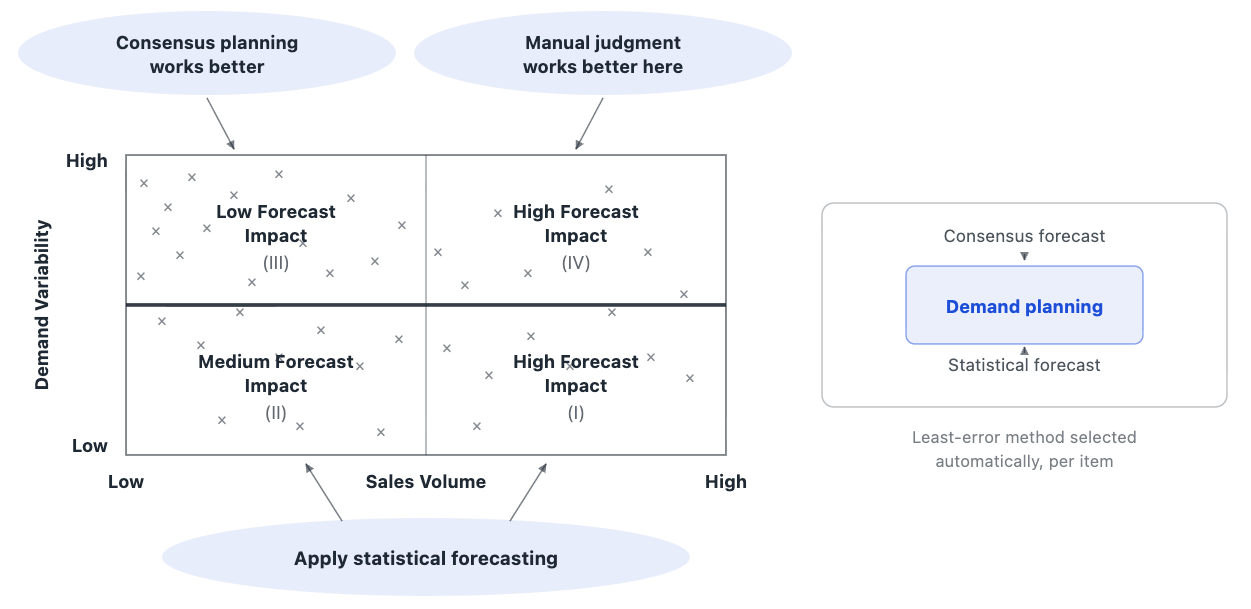
Nongshim combined statistical forecasting with consensus planning rather than using one method for every product. Statistical models generated an initial forecast and automatically selected the method with the lowest error, while planners could add judgment where market knowledge was more valuable.
The key was segmentation. Products were classified according to sales volume and demand variability. Stable products could rely more heavily on statistical forecasting, while volatile products required greater planner review. High-volume items received the greatest attention because even a small forecast error could have a meaningful effect on inventory, replenishment, and service.
This approach made forecasting more operational. The objective was not simply to improve a forecast accuracy metric; it was to generate a demand signal that could be translated quickly into inventory and replenishment decisions across the network. By focusing planner effort on the products with the greatest business impact, Nongshim could respond more effectively without requiring the same level of manual review for every item.
Replenishment: Turn Demand Changes Into Same-Day Action
Replenishment was the critical link between the demand signal and product availability. Nongshim's network included 6 CDCs and 48 RDCs, and not every location had the same sourcing options. Some RDCs could be replenished through only one route, while others could receive inventory from multiple upstream locations.
The planning system therefore evaluated inventory targets and sourcing choices together. It calculated required inventory by period, controlled minimum and maximum stock levels, and selected replenishment routes while considering both transportation and manufacturing cost. It also supported expedited orders and cross-docking when faster movement was required.
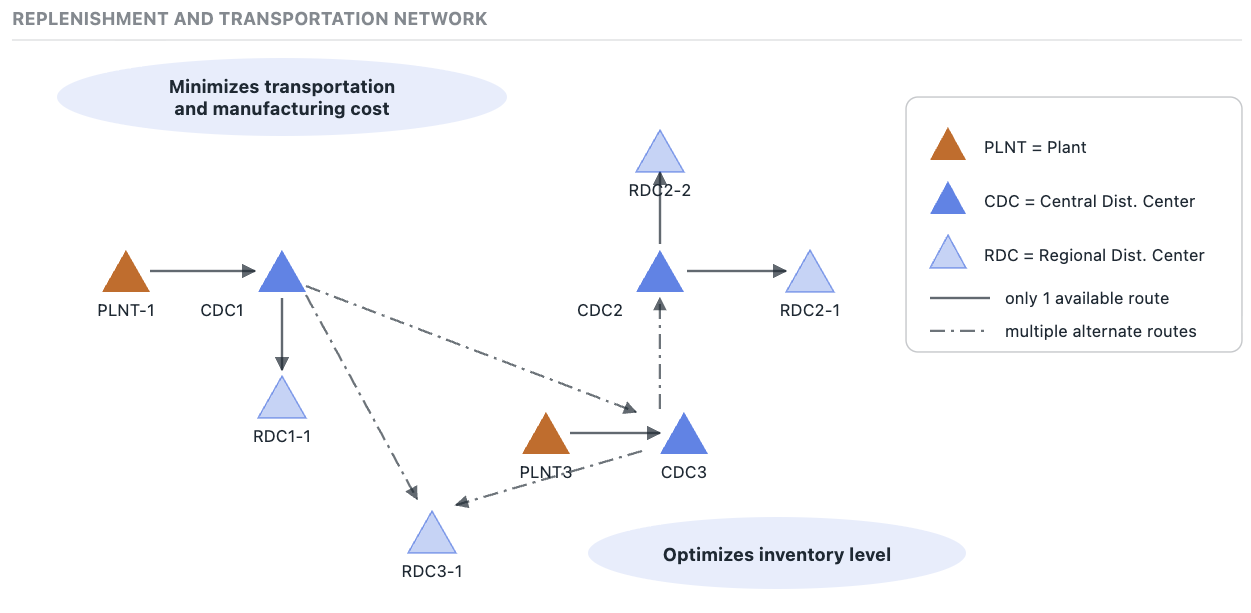
Replenishment planning considered inventory targets, available sourcing routes, transportation cost, and manufacturing cost together.
A major operating change was moving to at least two replenishment runs per day. The morning run supported regular scheduled deliveries based on the latest network inventory position. Later in the day, the system could identify items drawing down faster than forecast and trigger a second, smaller replenishment response.
That higher planning frequency is important because it connects forecast quality with actual service. A weekly process may identify a shortage only after the opportunity to respond has passed. A twice-daily process can detect an unexpected drawdown and reposition inventory before it becomes a stockout. This faster response contributed to reducing Nongshim's out-of-stock rate from 0.38% to 0.10%.
Order Promising: Convert Planning Into a Customer Commitment
Nongshim also connected planning with due-date quoting. The first three days of the confirmed production plan were treated as a demand time fence, reflecting both production stability requirements and the approximately three-day lead time for locally supplied raw materials.
This created a clear service rule: orders registered before 4:00 p.m. could be promised from D+3, while orders registered after 4:00 p.m. could be promised from D+4. Instead of waiting for a planner to review the schedule manually, the organization could provide a delivery commitment at order entry based on the current supply plan.
Production Planning: Make the Supply Plan Executable
Production planning remained important, but its role was downstream: convert replenishment requirements into a feasible operating plan. Demand was first allocated across plants based on production and transportation considerations, and each plant then created a detailed schedule using its own capacity and operating constraints.
The scheduler accounted for practical rules such as batch sizes, material lead times, labor availability, shared packaging equipment, line preferences, and sequence-dependent changeovers. For example, project documentation shows a 15-minute changeover in one direction between two noodle products but a seven-hour cleaning requirement in the reverse direction.
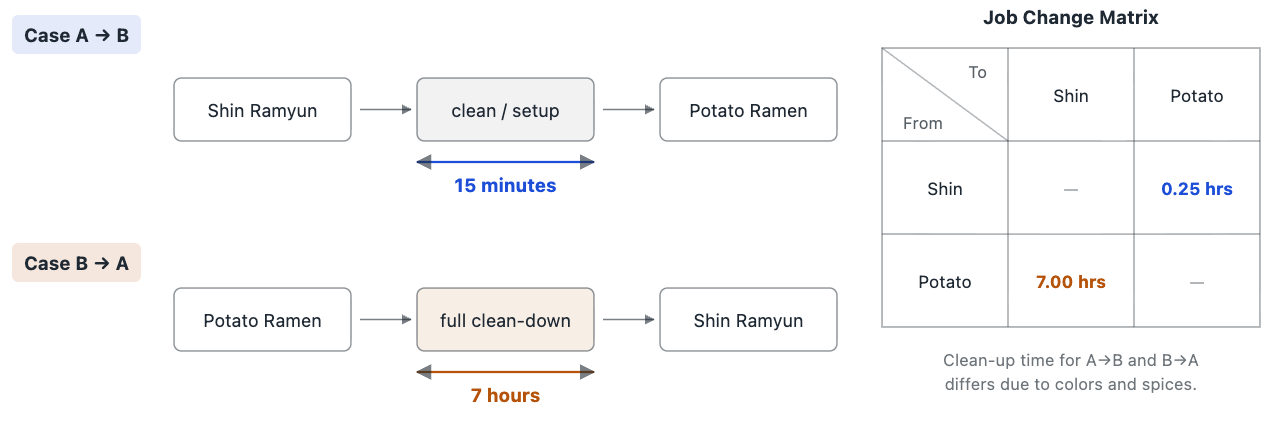
Sequence-dependent changeover times were modeled so production schedules reflected actual cleaning and setup requirements.
Daily Planning and ERP–MES Integration
The redesigned process established a weekly planning baseline with daily adjustments for order, inventory, production, and material changes. Major master data—such as bills of material, routings, work centers, and item masters—remained in ERP, while production constraints, planning policies, and scheduling strategies were managed in the APS environment. Planning and execution data were exchanged with ERP and MES in real time.
Measured Results
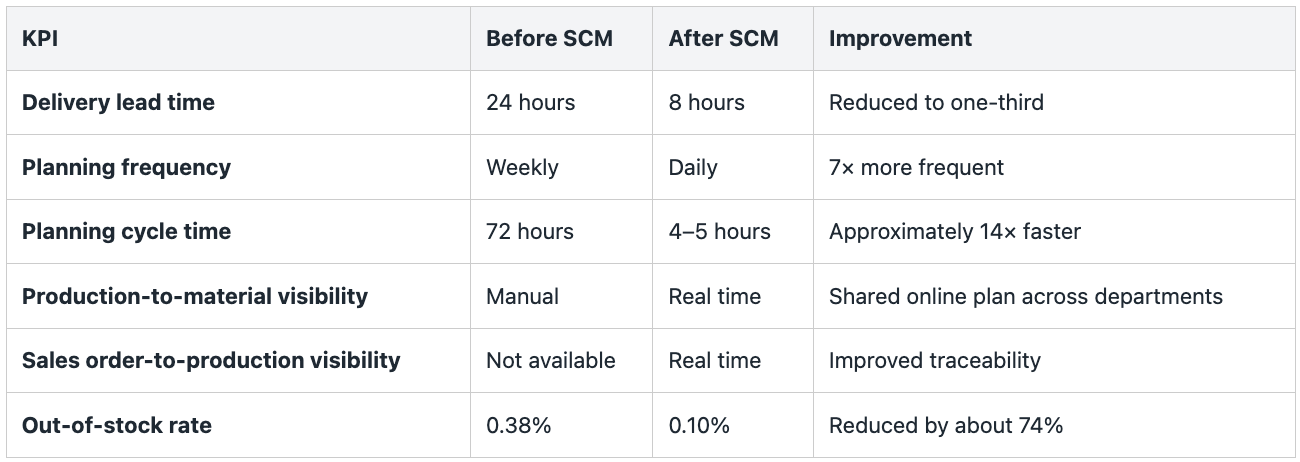
Project ROI: 0.28 percentage-point reduction in out-of-stock rate represented about $5~7 million in annual value.
The most important improvement was response speed. Reducing the planning cycle from 72 hours to 4–5 hours made daily planning practical, while more frequent replenishment allowed Nongshim to react to demand and inventory changes before they became customer-service problems.
Creating Value through Integrated Planning
The Nongshim project shows how demand planning creates more value when it is directly connected to replenishment. Forecast segmentation determined where planners should focus attention, while frequent replenishment converted new demand and inventory information into operational action. Production planning then ensured that the resulting supply requirements could be executed.
These capabilities—demand planning, inventory and replenishment planning, plant allocation, and constraint-based production planning—form part of the foundation of Zionex's current supply chain planning solutions, including PlanNEL.
This case study is based on Nongshim SCM project documentation from the original implementation period. Company scale, international operations, and current system architecture may have changed since the project was completed.